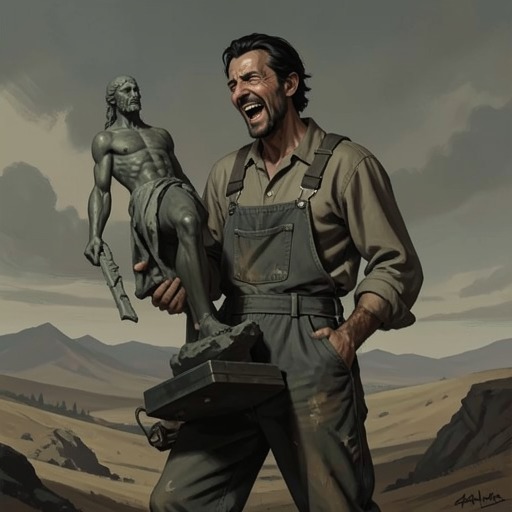
Divine Boy’s Iconoclasm
Last and First MenDivine Boy’s Iconoclasm turns the Divine Boy’s challenge to the religious order of Patagonia into a public act: during a ceremony in the capital’s supreme temple, he breaks the Creator’s image before the congregation. Arrested and executed for sacrilege, he becomes a martyr to a movement that carries his teaching far beyond its original setting, even as followers give the destruction more emphasis than the ideas behind it.
The Prophet and His Message
The act followed a life that set the Divine Boy apart from his fellow Patagonians. While many of his contemporaries showed signs of senescence, he remained physically young and retained an unusual agility of mind. At forty, after years of developing his ideas, he delivered a mature teaching that few around him could fully understand. His earlier gospel had already become popular because it spoke to a deep Patagonian desire for renewed vitality.
That mature teaching challenged worship based on deference to divine power. The Divine Boy urged his listeners to keep the suppleness of youth while continuing to grow in skill and understanding. He presented life as a serious game in which the quality of playing mattered more than simply winning. In the temple, he applied this outlook to religious devotion: rather than seek favors through submission, worshippers should put aside their adulation of power and reconsider the image they had made sacred.
The Temple Confrontation
The confrontation took place during a ceremony in the capital’s supreme temple. The worshippers lay prostrate before the Creator’s image when the Divine Boy strode to the altar. He looked first at the congregation and then at the idol, laughed, and slapped the image. He mocked the contrast between its appearance and the reverence it commanded, then rebuked the congregation for treating solemn ritual as an end in itself.
His challenge was not simply that the image was unworthy of worship. He condemned the worshippers’ dependence on adulation and their attachment to life without the maturity to live it well. His appeal joined the demand to remain young with the demand to grow up: vitality, in his account, meant developing a finer capacity to take part in life, not clinging to childishness. The congregation fell silent and listened, a response the narrative links to his confidence, radiance, and reputation as a miraculous figure.
He then made the appeal physical. Taking a great candlestick, he shattered the idol and urged his audience to break the corresponding image in their own hearts. The gesture made the inward challenge unmistakable: the object of worship was destroyed in the very place where its authority had been enacted.
Arrest, Execution, and Reception
The destruction provoked an uproar. Temple authorities arrested the Divine Boy; he was tried for sacrilege and executed. The account presents the act as the culmination of earlier indiscretions and says that those in power welcomed the clear pretext it gave them to eliminate a brilliant but dangerous figure. His public challenge thus ended in state and religious punishment, rather than an immediate transformation of the institution he confronted.
Execution did not extinguish the movement. The cult of the Divine Boy was already popular, and his followers accepted even his final, difficult message, though without fully understanding it. They emphasized the dramatic iconoclasm more than the exhortation to mature. The religion spread across the civilized world over successive centuries, bringing a degree of spiritual and physical rejuvenation. The narrative attributes the physical revival to the propagation of the prophet’s unusually vital strain, which contributed to Patagonia’s golden age and renewed the civilization’s material and intellectual energies.
Meaning and Historical Irony
The episode’s force lies in the gap between the Divine Boy’s teaching and the form in which it survives. He sought to free his audience from unreflective worship and to make vitality inseparable from growth. His followers preserved the most visible part of his protest—the broken idol—more readily than its demand for a deeper change in how they lived. The gesture that challenged religious submission consequently became the defining sign of a new cult.
The authorities’ response also gives the scene its immediate political consequence: an act performed before the community’s central sacred image brings the prophet into direct conflict with those who control the temple. His execution removes him, but not the appeal of his example. In the history that follows, the iconoclasm both marks the cost of his challenge and supplies the movement with an enduring emblem, while the partial reception of his message foreshadows the distance between the prophet’s vision and its later popular form.